 bonesbalance
Imagine waking up and getting ready to start your day — but as you swing your legs out of bed, you freeze. That sharp pinch in your lower back reminds you, once again, that you’re dealing with a herniated disc. Simple things like tying your shoes, picking up your child for a hug, or sitting through a work meeting suddenly feel difficult. It can be frustrating, tiring, and even isolating.
But here’s the good news: you can take back control. The right exercises and gentle stretches can help ease that tension, reduce nerve pain, and get you moving again — one step at a time. With a little daily movement, you can stop dreading simple tasks and start enjoying life’s small moments again. Slowly, standing, twisting, and bending will feel easier, without that sharp pain holding you back. You deserve to feel better — and you can get there, one stretch at a time.
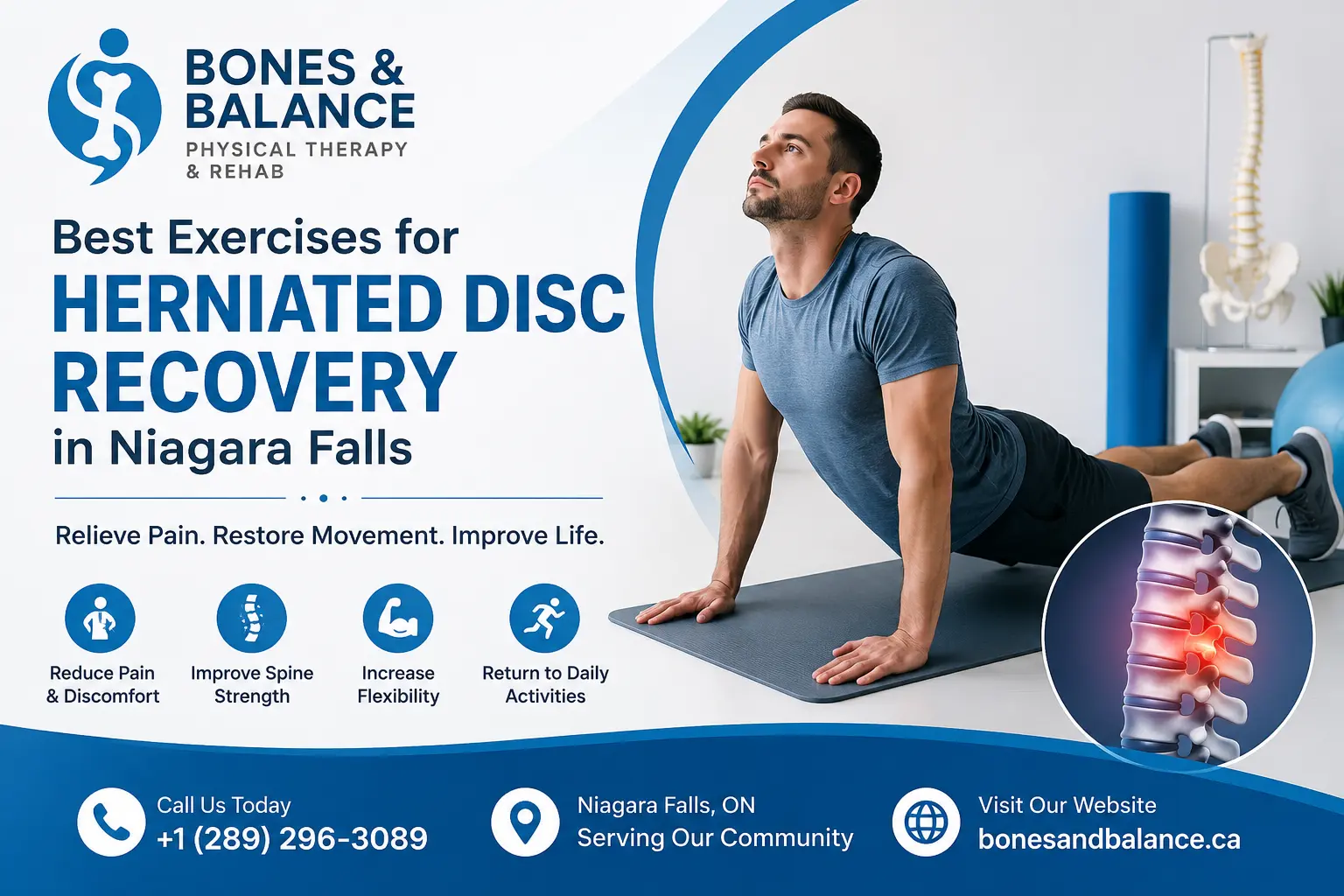
Best Exercises for Herniated Disc Recovery
A herniated disc can turn even simple daily tasks — bending to pick something up, sitting at a desk, or getting out of bed — into a painful struggle. The good news is that movement, when done correctly, is one of the most powerful tools for recovery. The right exercises can ease pressure on the affected disc, reduce nerve irritation, and rebuild the strength needed to prevent future flare-ups.
At Bones & Balance Physical Therapy & Rehab in Niagara Falls, we guide patients through safe, progressive exercise programs designed specifically for herniated disc recovery. This guide answers the most common questions people ask about exercising with a herniated disc — and outlines exercises that are generally considered safe, along with movements to avoid.
Disclaimer: Every herniated disc is different. The exercises below are general guidance, not a replacement for a personalised assessment. Always consult a physiotherapist before starting a new exercise routine, especially if you’re experiencing pain that radiates into your leg.
What Is a Herniated Disc?
A herniated disc — sometimes called a slipped or ruptured disc — happens when the soft inner core of a spinal disc pushes through a crack in its tougher outer layer. According to the Mayo Clinic, this can irritate nearby nerves, leading to pain, numbness, tingling, or weakness.
Can Exercise Help a Herniated Disc Heal?
Yes. While it may seem counterintuitive to move when you’re in pain, gentle and targeted exercise is one of the most effective ways to support healing. Movement increases blood flow to the affected area, which helps reduce inflammation and supports tissue repair. Exercise also strengthens the muscles that support your spine, taking pressure off the injured disc and reducing the likelihood of re-injury.
Research consistently shows that structured exercise programs — particularly those focused on core stability and controlled movement — lead to meaningful improvements in pain and function for people with disc herniation, often without the need for surgery.
What Are the Best Exercises for a Herniated Disc?
The most effective exercises for herniated disc recovery generally fall into three categories: core stabilisation, gentle stretching, and low-impact aerobic activity. Below are some of the most commonly recommended exercises — though the right combination for you depends on your specific condition and should ideally be guided by a physiotherapist.
7 Best Exercises for Herniated Disc Recovery (And What to Avoid)
1. Pelvic Tilts
Lie on your back with your knees bent and feet flat on the floor. Gently tighten your abdominal muscles and flatten your lower back against the floor by tilting your pelvis slightly upward. Hold for a few seconds, then release. This is a gentle introduction to core activation and is often one of the first exercises introduced in recovery.
2. Bridges
From the same starting position as pelvic tilts, lift your hips off the floor by squeezing your glutes, forming a straight line from your shoulders to your knees. Hold briefly, then lower back down. Bridges strengthen the glutes and lower back, which helps take pressure off the spine.
3. Bird Dog
Start on your hands and knees. Extend one arm forward and the opposite leg backwards at the same time, keeping your core engaged and your spine neutral. Hold for a few seconds, then switch sides. This exercise builds core strength while teaching your body to maintain spinal stability during movement.
4. Cat-Camel Stretch
On your hands and knees, slowly arch your back upward (like a cat), then gently lower it into a slight downward curve (like a camel). Move slowly and within a comfortable range. This stretch improves spinal mobility and can help relieve stiffness.
5. Knee-to-Chest Stretch
Lying on your back, gently pull one knee toward your chest while keeping the other leg flat or bent. Hold for 20–30 seconds, then switch sides. This can help relieve tension in the lower back.
6. Hamstring Stretches
Tight hamstrings can pull on the lower back and worsen disc-related pain. A gentle seated or lying hamstring stretch — reaching toward your foot with a straight leg until you feel a mild stretch — can help reduce this tension when done regularly.
7. Walking
One of the simplest and most effective exercises for herniated disc recovery is walking. It’s low-impact, improves circulation, and helps maintain mobility without placing excessive strain on the spine. Starting with short, frequent walks and gradually increasing duration is a good approach.
Are There Exercises I Should Avoid With a Herniated Disc?
Yes — certain movements can place excessive stress on the spine and may worsen symptoms. While every case is different, the following are generally approached with caution during recovery:
- High-impact activities, such as running or jumping, create repetitive jarring forces on the spine
- Heavy lifting, especially when combined with bending or twisting
- Twisting movements, which can increase pressure on the disc
- Traditional sit-ups, which place significant compressive force on the lower back
- Deep backbends or excessive spinal extension, which can stress the joints at the back of the spine
If a particular exercise causes sharp pain, numbness, or tingling that travels into your leg, stop immediately. These can be signs that the movement isn’t right for your stage of recovery.
How Often Should I Exercise With a Herniated Disc?
Consistency matters more than intensity. Many people begin to notice improvements with gentle exercise performed two to three times per week, gradually increasing as tolerated. Starting slowly and progressing under professional guidance helps ensure you’re building strength without overloading the healing tissue.
This is where a personalised plan makes a real difference — what’s appropriate in week one is often very different from what’s appropriate by week six. If you’re also managing related symptoms, our guide on joint pain symptoms you shouldn’t ignore may help you understand when it’s time to get a proper assessment.
Are Yoga or Pilates Safe for a Herniated Disc?
Both can be beneficial, but with caution. Pilates tends to be gentler on the spine because it emphasises controlled, stable movement without extreme ranges of motion — making it a popular choice during disc recovery. Yoga can also help with flexibility and stress reduction, but certain poses involving deep twisting, forward folding, or backbends may need to be modified or avoided entirely, depending on your condition.
If you enjoy yoga or Pilates, it’s worth discussing your specific routine with a physiotherapist so they can flag any poses that may not be suitable for you right now.
When Should I Stop Exercising and See a Physiotherapist?
Pay attention to how your body responds. You should stop the exercise and consider booking an assessment if you notice:
- Pain that worsens during or after exercise
- New or increasing numbness, tingling, or weakness in your leg or foot
- Pain that radiates further down your leg than before
- Difficulty walking or standing after activity
If your symptoms are connected to a fall, accident, or injury, our MVA rehabilitation program is designed to support recovery with a structured, personalised plan. And if your symptoms include nerve pain travelling down your leg, you may find it helpful to read our article on physiotherapy for sciatica, which covers a closely related condition.
Why Work With a Physiotherapist for Herniated Disc Recovery?
Exercise is powerful — but only when it’s the right exercise, done the right way, at the right stage of your recovery. A physiotherapist starts with a thorough assessment to understand exactly what’s happening in your spine, then builds a program that progresses safely as you improve. This personalised approach reduces the risk of doing too much too soon, while making sure you’re not avoiding movement that would actually help you.
About This Article
This article was prepared by the clinical team at Bones & Balance Physical Therapy & Rehab, a physiotherapy clinic in Niagara Falls, Ontario. Our licensed physiotherapists have hands-on experience helping patients recover from disc-related back and leg pain using individualised, evidence-informed exercise programs. The information here is intended as general education — for guidance specific to your condition, we recommend booking an in-person assessment.
Frequently Asked Questions
What is the fastest way to recover from a herniated disc?
There’s no single “fastest” fix, but a combination of guided exercise, manual therapy, and gradual return to activity tends to produce the best outcomes. Most people see meaningful improvement within several weeks of consistent, appropriately-paced treatment.
Can a herniated disc heal on its own?
In many cases, herniated discs improve over time as inflammation reduces and the body adapts. However, recovery is often faster and more complete with an active rehabilitation program, since it addresses the muscle imbalances and movement patterns that may have contributed to the herniation in the first place.
Is walking good for a herniated disc?
Yes, for most people, walking is one of the safest and most beneficial activities during recovery. It promotes circulation and mobility without the impact of running or jumping. If walking increases your symptoms, it’s worth getting assessed to understand why.
Should I rest completely if I have a herniated disc?
Prolonged bed rest is generally not recommended. While some initial rest can help during a flare-up, staying completely inactive for too long can lead to stiffness and weakness that make recovery harder. Gentle movement, introduced appropriately, is usually more beneficial than complete rest.
How do I know if an exercise is making my herniated disc worse?
Warning signs include increased pain during or after the exercise, new numbness or tingling, or pain spreading further into your leg. If you notice any of these, stop the exercise and consult a physiotherapist before continuing.
Get a Personalised Recovery Plan
Recovering from a herniated disc doesn’t have to mean guesswork. At Bones & Balance Physical Therapy & Rehab in Niagara Falls, our team can assess your condition and build a step-by-step exercise plan tailored to your body and your goals. Visit our homepage to learn more or book an appointment today.
